The logistics industry is in a period of accelerated change, driven by technology development, shifting global trade patterns, and increasing demands for efficiency and transparency. As we approach Logistics & Automation in Stockholm, many of these changes are not isolated trends but interconnected developments reshaping how supply chains are designed and operated.
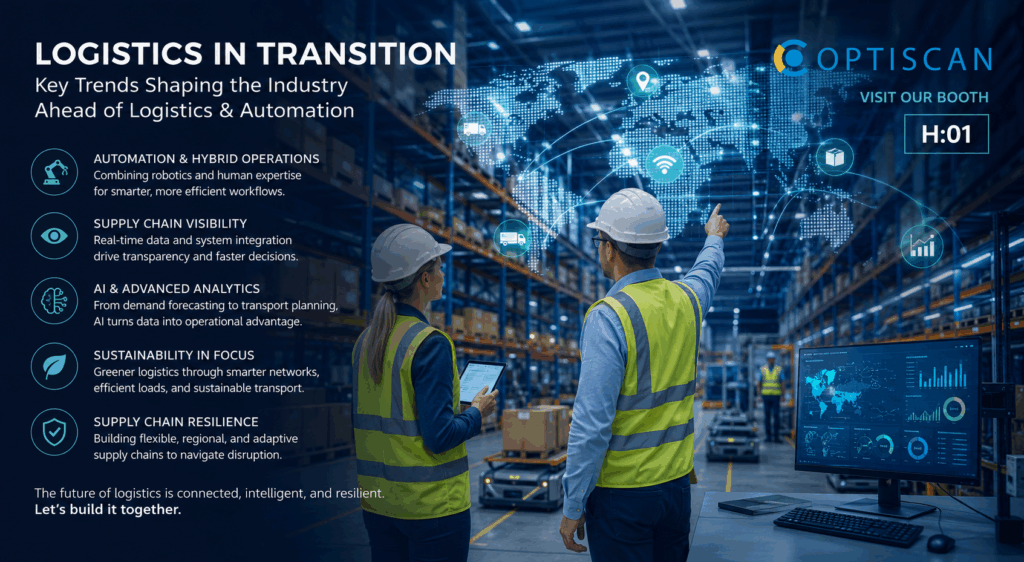
One of the most visible shifts is the continued rise of automation in warehouse and distribution environments. Rather than being a future concept, automation is now a practical part of daily operations in many facilities. Companies are increasingly combining robotics, automated storage systems, and intelligent software to support picking, packing, and internal transport. However, the most effective implementations are not fully automated environments, but hybrid models where human expertise and machine efficiency complement each other.
At the same time, visibility across the supply chain has become a central requirement rather than a competitive advantage. Organizations are investing in real-time data platforms that allow them to monitor goods, predict delays, and respond quickly to disruptions. This development is closely linked to improved system integration, where data from multiple sources is brought together to create a more accurate operational picture.
Artificial intelligence (AI) and advanced analytics are also playing a growing role, particularly in demand forecasting, inventory optimization, and transport planning. These tools are helping logistics operators move from reactive decision-making toward more predictive and scenario-based planning. However, their effectiveness depends heavily on data quality and the ability to integrate across legacy systems, which remains a challenge for many organizations.
Sustainability continues to be a key driver of change. Logistics networks are being redesigned to reduce emissions, improve load efficiency, and support more sustainable transport modes. This is no longer limited to corporate responsibility initiatives but is increasingly influenced by regulation, customer expectations, and cost efficiency considerations.
Finally, supply chain resilience has become a priority following recent global disruptions. Many companies are re-evaluating their dependency on long and complex supply chains, instead shifting toward more flexible and regionally diversified models.
From an industry perspective, including insights observed by Optiscan Group, the common denominator across these trends is the need for better-connected systems and higher-quality data flow. Without this foundation, even advanced technologies risk delivering only partial value.
Logistics & Automation provides an important platform to discuss these developments, share experiences, and explore how the industry can move toward more integrated and resilient supply chain models.
We also invite you to visit the Optiscan booth (H:01) to discuss how we can help optimize your logistics operations and support your transition toward more connected, data-driven supply chain performance.